That beauty? It’s a potato!
Similar to English society, the English garden is a difficult to comprehend mixture of rules and nonchalance. The first time I saw the local legend of gardening at Sissinghurst, I began to try and discover the secret of English gardeners.
If you ignore the climate, the Brits approach plants in the same way as they approach children. They believe in thorough pruning, long-term formation, neat separation. They approach the garden with a plan, which they implement with the help of a pair of compasses and a ruler. The charmingly dishevelled appearance of English gardens is only the cherry on the cake of rigorous planning, geometrically precise preparations and a lot of effort.
When we first acquired a small house in London (“you gave up a view of Petřín for this?!”) I took English ladies by surprise with my ‘original’ style of gardening. “What’s this unusual plant you have? The one with the purple flowers?”
“Erm…it’s a potato…” A few of them had turned green in the cupboard, and as a girl from the East I put them into the ground instead of in the bin. A century ago, most Brits had no clue what the plant of the most commonly used crop looked like.
My mother-in-law (Lady Harris), fearing that I would become a social outcast through my vegetable-growing originality (I planted carrots and the kids from our street pulled them up after coming back from nursery, munching on them and boasting at home that they attended a carrot party), paid for a gardener for my birthday. Steve used to be a City banker, before one Monday morning deciding that life is too short. At first, it looked like he hadn’t done much in the garden (a classic London noodle-like strip), but then suddenly it was transformed. Using a plank he had brought with him, he painstakingly trimmed the borders of the lawn with a spade. Suddenly the asters in the neighbouring flowerbed didn’t look as tired and neglected, but instead ‘effortless’ in the English way (he raised them up with a support hidden among the flowers). He clipped the tangled bushes so that the blooms on their almost geometrically ordered background would stand out. I wished then my birthday were every month!
Murders in the Garden
Gardeners are brutal types. Can you imagine the kinds of cruel, cold-blooded murders they carry out? I advise the faint-hearted to skip the following paragraph. Zdena, an intellectual beauty, is showing me how this year’s flowers are thriving, when suddenly her charming face twists, she turns red with rage and a sharpened sickle gleams in her hands. With a single sweep she cuts the victim, which was feasting on her delicate seedlings, in half. Gardeners’ various methods of slug extermination can equate to criminological classifications of murders. Some plug them into plastic containers, filling it until a few months later only a grizzly, smelly mess remains. Others scatter their plants with carpets of granules and then scrape the brown corpses onto the compost heap. Others still salt them and watch the pests trickle and perish. One neighbour would collect them in buckets in the evenings and mornings, carrying them to the woods. Even the most passionate of gardeners, King Charles, couldn’t hold back and protested when the English media expressed progressive opinions on defence against slugs.
Gardeners’ hatred towards pests and enemies shouldn’t be underestimated. Some say, let the bug live. Sure, but only if it doesn’t eat the majority of your salad before the morning.
Hortus conclusus
In the middle ages, during periods of chaos, wars, and eternal danger, the hortus conclusus emerged, an enclosed garden which was both a blissful oasis and a place of refuge. During the pandemic (where I was gratefully confined to the garden), my dreams came true. Like in one of Klimt’s paintings of the countryside, speckled hens would promenade under the old plum trees and freshly planted cherry trees; they floated over the overgrown grass like little boats. The wind rippled through their soft feathers, rising as gently as the freshly sprouted leaves of a young linden tree. The romanticism of an old painting by Bauernhouse (one of the most commonly reproduced images) documents people’s wisdom, which has fallen by the wayside: hens would be let into orchards to get rid of pests and ensure the fruit trees’ health. The young cherry trees miss the hens even more than I do now! A garden needs movement: buzzing, chirping, and clucking. (Healthy hens don’t leave a sticky mess behind in the grass, but instead a painstakingly rounded ‘cake’ with a white cap, which promotes the growth of roses. Farmers didn’t choose their animals according to which would taste the best, but according to how big a piece of land they needed to fertilise.)
The Fight for Organic
As a child, whenever I got a fever or an epileptic seizure, my father saw a small coffin before his eyes. He placed his two-year-old son in one, when neither doctor nor any of the half dozen healers with whom he pleaded could save him. He even began to correspond with a leading Swiss nutrition expert. Later, he planted an expansive orchard, knocking me into the shape of a frenzied grower of organic produce. It’s the same obsession that Tolstoi suffered from. In his novel Anna Karenina, he exquisitely describes the unbearable suffering during visits from towns through his alter ego Lensky; how he urges the guest to sit peacefully and have a drink, meanwhile his hands itch and he is tortured by this godless squandering of a summer’s day, when every gardener (a.k.a. farmer) needs at least 48 hours in a day.
“That’s what I’d like,” one such visitor nods to her husband. I was amused. The professor was apparently convinced that my lovely wilderness simply awaits me whenever I unlock the gate. No, not quite. Everything deserving of the adjective ‘lovely’ is hard work.
Nature is like an all-devouring, insatiable monster. If you let her have her way, you give her free rein and she will soon gobble the garden up.
But when lightning strikes down a hundred-year-old cherry tree, I let her lie there. I cut the branches with drying leaves, but I don’t rush to clear the trunk. I once saw it in the park of Knole House where Henry VIII used to hunt deer in his time. It’s incredible how much strength and life there is in a fallen tree trunk, and how many grateful inhabitants make their home there. The Austrians (like us) immediately chop a tree down when a few of its branches dry up and promptly cut it up for firewood.
The English, on the other hand, let even a decaying tree stand, planting roses at its base, which gratefully twine around it. Nothing compares to the dignity of an old tree. Part of my garden in Maříž is more like a woodland park. But I have trimmed the branches of larger trees in a way that I can pass beneath them. This means that light can also freely filtrate through adult trees and the eyes can marvel at the distant horizon. One visitor (with a great imagination) marvelled at the scene, saying he felt like a wide lake was unfolding behind the garden.
English roses (like children) turn out best when they have a routine. In the autumn, they are pruned and fastened with mathematical precision to hoops made from hazel rods. When you see them in June, covered in blossom, you would never guess that each branch was pruned and fastened in a symmetrical arc, as though with a pair of compasses.
Other trivialities
When I attempted a puddle/pond in which my daughter (then an infant) could watch tadpoles turn into frogs, I discovered that the English have two methods. When I heard what the first one involved, I never bothered with the second one. You simply fill a tarpaulin weighed down with stones with rainwater. They call it the ‘natural’ method. After fifty years, I still apply the ‘natural’ method to almost everything in the garden. A few weeks ago, I discovered through the Financial Times that by doing so, I’d – just – transformed from a lazy gardener to a ‘revolutionary’ one. My (controlled!) tolerance of all sorts of weeds among noble flowers is incredibly desirable to the original flora which had previously been killed by chemicals.
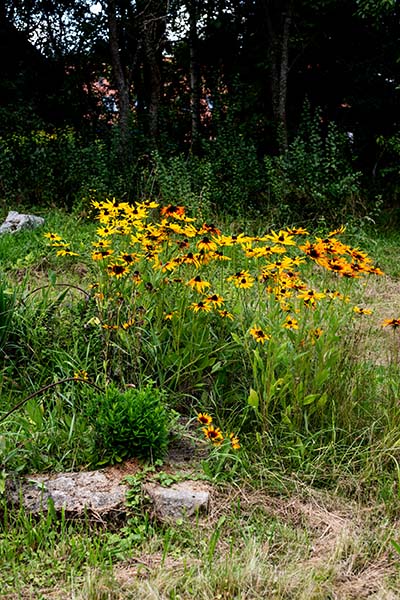
When I like a weed, I let it laze around in the flowerbed. Charming field bluebells don’t require substrate. When Rudbeckia run away from my painstakingly bordered (with granite) flowerbed into the surrounding area, I watch with joy every year as they mingle with St. John’s-wort, Knautia and clover.
For a few years, I had neither the strength nor money to mow the plot of land more than once a year; in the meantime, a marvellous meadow bubbled up, a carnival of meadow flowers like from my childhood, when my father would mow the dewy grass at dawn with a razor-like scythe. Since then, I have been dreaming of saving Czech lands from the talons of Mountfield. Restoring sacred silence, the dance of butterflies and the magnificently coloured and statesmanlike beetles will begin with the public execution by the ‘Wheel’ of the indefatigable Jiřina Bohdálová, who has been helping to contaminate the world with ear-splitting machines.
There is no corner of Czech paradise which isn’t cursed by the shattering, ear-splitting sound of lawnmowers of all kinds. And this legendary actress plays a large role in it.
It would suffice to mow small paths – to the compost, the gate, the flowerbeds or the swing…the garden will become elegant from the wind rippling through the grass, multi-coloured butterflies dancing above, bees and wasps buzzing; it will come to life. There is nothing more uplifting and inspiring then returning life where it was starting to fade. And the silence! It heals.
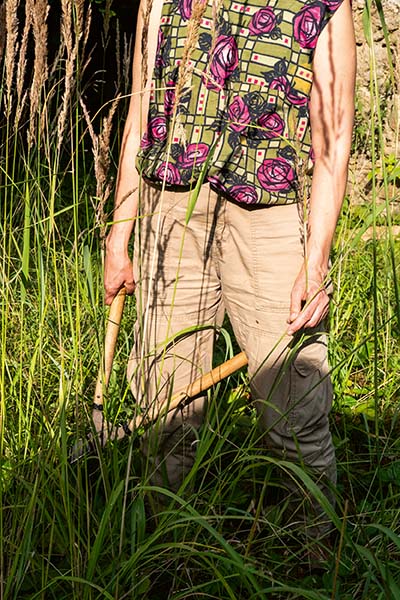
“Just say the word, miss, I’ll take a lawnmower and in half an hour it’ll all be gone!” This sentence best captures the popular method of Czech gardening. First, raze everything to the ground, before starting again. My mother refused to use the word gardener, instead, she’d say ‘idiot.’ But coming into contact with this approach helped me enormously. I was a drop more prepared for when my manicured garden was devastated by a tornado during the pandemic. It came as a shock; in the evening, you’re inhaling the scent of flowers and admiring their grouping, and then in the space of half an hour there is havoc, colourful scraps and shreddings as far as the eye can see. No one but the gardener knows so many new beginnings.
But a live fence will survive even a tornado, and you won’t have to worry about where to find money or builders for a new one. And you’ll be helping the flora and fauna recuperate. You can find a video on YouTube of the (then) Prince Charles demonstrating how to best plant a live fence. (My method is once again natural: the birds perching along the rotting wooden fence ‘plant’ all manner of bushes and trees; then I simply shape them into a green barrier.)
Geranium robertianum
The Irish writer Edna O’Brien wrote that a romantic has a sound mind and unbridled actions. I bought my largest plot in the heart of Maříž, what was then a forgotten, dilapidated border village, for an absurd amount, because the owner told me that otherwise, speculators would divide it up and sell it in pieces. This year marks the fifteenth year I’m recovering from this foolish gesture.
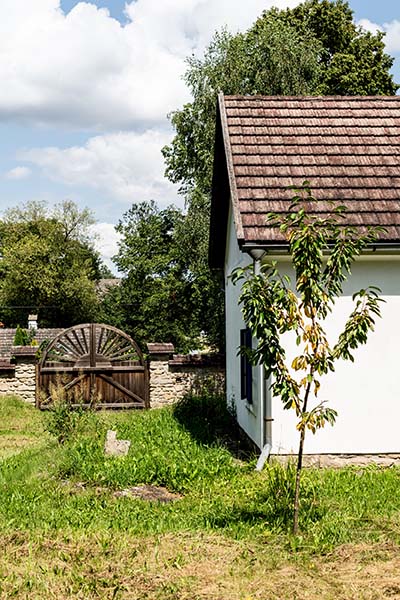
“While you were away your field of gladiolas dazzled us,” the neighbour (a gardener) said in awe. My obsession with gardens in countries that are two thousand miles apart is absurd. But I can’t help myself. They are where I can think the best, where I have no control but am simply part of a greater whole; nowhere else can I find more interesting colours, more wonderful shapes and smells, and the sounds of hundreds of incredible creatures. As my ninety-two-year-old friend and gardener Ian says, ‘I’m still learning.’ (He taught me how to use Japanese shears to cut the grass, and then gifted me a pair. I later found out that this kind of cutting is now termed ‘grass meditation’ and you can have the pleasure of perfecting it on a course that costs $3000.)
Just now, we were pruning the old magnolia in the garden with my seventeen-year-old son. Encyclopaedia Britannica defines gardening as an activity that helps preserve beauty and increases the value of a property. For me, the garden has been my personal psychiatrist for half a century. Without saying it out loud, I’m trying to show my teenager, too, that gardening can be a soft and effective remedy for the soul’s pains.
P.S. Gardening is human’s battle with nature. And humans should enjoy their defeat.
Photo: Natálie Bartošová
This article appeared in the seventh issue of the print magazine N&N – Noble Notes